
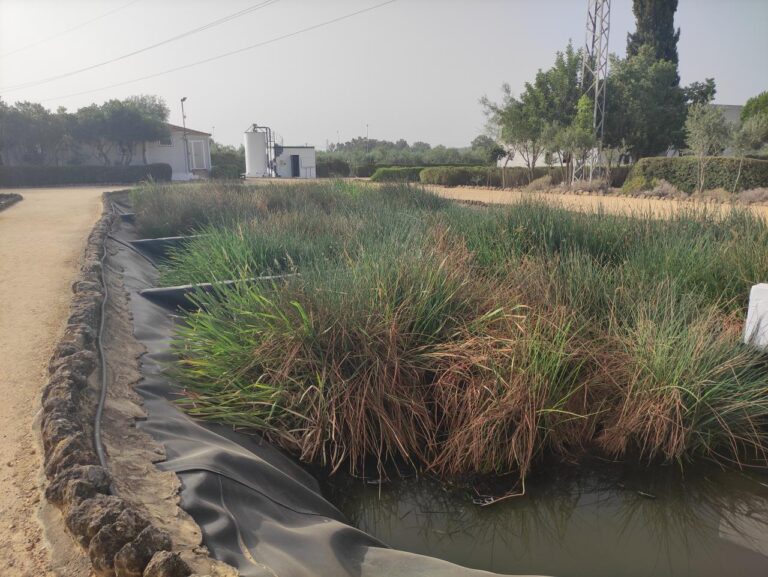
Case Study is located in the Experimental Centre of New Water Technologies, in Carrión de los Céspedes, in Seville (Andalusia, Spain). It is as a living lab for the collaborative development, testing, and evaluation of innovative solutions in the fields of water management, wastewater treatment, and circular economy. It also hosts numerous training activities involving a wide range of stakeholders. Covering a current area of 4.1 hectares, the centre has several types of Nature-based Solutions (NbS) for wastewater treatment, including Constructed Wetlands (CW), sand filters, lagooning system, high-rate algal ponds, permeable reactive barriers, and floating gardens.
The area is characterized by a hot-summer Mediterranean climate (Csa) according to the Köppen classification. In Carrión de los Céspedes, summers are short, hot, dry, and mostly clear, while winters are mild to cold and partly cloudy. The site is located approximately 70 km from Doñana National Park, a protected natural area, home to a mosaic of ecosystems that harbour a unique biodiversity in Europe.
The region faces several water-related challenges, particularly associated to seasonal dry, drought and water scarcity, stored water quality, water pollution and runoff, diffuse pollution of aquifers by fertilisers, evaporation, and the effects of climate change. Agriculture is one of the main economic sectors in the area. Most of the agri-food activity it is dedicated to rain-fed agriculture as sunflower and olive grove and irrigated agriculture as sunflower, olive grove and almonds. Fruit trees are acquiring an important extension limited by the need for irrigation.
The main objective of this case study was to enhance the treatment of wastewater for its reuse in irrigation, while improving both the quantity and quality of treated water stored for agricultural purposes. This work was carried out in the context of increasing water scarcity and climate change impacts in the region, which highlight the urgent need to identify alternative water sources for agriculture and to ensure the protection of aquatic ecosystems.
–


This project has received funding from the European Union’s PRIMA Research and innovation programme under Grant Agreement No 2221.