
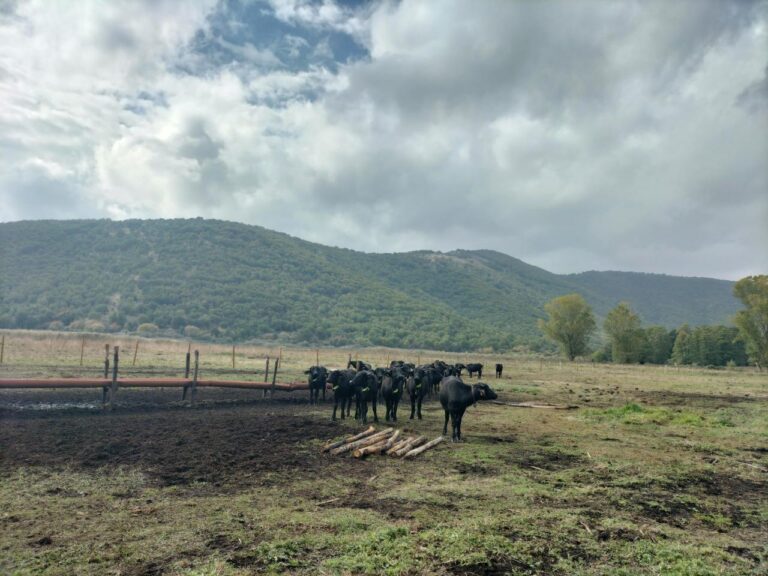
This Case Study corresponds to the Chimaditida lake complex, located in Western Macedonia (Northern Greece) within the Regional Unit of Florina. The area belongs administratively to Amyntaio Municipality. The four lakes conforming the complex are hydrologically connected, through artificial canals and ditches, and includes the lakes of Zazari, Chimaditida, Petron and Vegoritida.
Lakes Chimaditida and Zazari belong to the Natura 2000 Network (total area of 40,64km²), and they are also designated as Special Protection Areas and Special Areas of Conservation. For instance, lake Chimaditida and its surrounding wetlands provide habitat for more than 141 bird species, from which four are endangered at European level. Local flora is also rich, comprising more than 150 plant species, from which 20 are considered important for their rarity in Greece, including the partially submerged communities growing on the wetlands around the lakes, the submerged communities, and peatlands. In addition, 114 species of phytoplankton have been identified, which shows the eutrophic character of the lake.
The lake infrastructure, the linkage of the four lakes, was developed in order to use water for irrigation purposes, as the main land use of the Amyntaio Municipality is agriculture (arable annual crops, vineyards or tree orchards), followed by pasture land. Most of the population work as farmers and stockbreeders. Vineyards are an ancient crop and produce unique, world-famous wines. The area is characterized by a hot-summer Mediterranean climate (Csa) according to the Köppen classification.
The main objective of this case study was the conservation and restoration of Lake Chimaditida and to strengthen the capacity of natural wetlands to store and treat water through improved natural management and better control of pollution discharges
–



This project has received funding from the European Union’s PRIMA Research and innovation programme under Grant Agreement No 2221.